NFL Live Betting in the UK: In-Play Markets, Timing and Strategy
 Available in US
NFL Live Betting in the UK: The Fastest-Growing Market
It was the third quarter of a Monday Night Football game — about 02:15 UK time — and I watched the live spread swing by four points in under sixty seconds. A fumble at the goal line, a momentum shift visible on camera before the stat tracker updated, and suddenly the underdog’s price offered genuine value. I placed the bet, it landed, and that single moment did more to convert me to in-play wagering than any amount of theory ever could.
Live betting is the leading segment of the sports wagering market, and for good reason. Platforms that have integrated live streaming alongside their in-play odds report a 25% increase in user engagement compared to those that offer only pre-match markets. The format suits how people actually consume sport: reactively, emotionally, and with a running commentary in their heads about what will happen next. NFL football, with its natural stoppages between plays, is arguably the sport best designed for live betting — each pause gives you a window to assess, decide, and execute before the next snap.
For UK punters specifically, NFL live betting occupies an unusual time slot. The majority of games kick off between 18:00 and 01:15 GMT, which means you are betting from your sofa late in the evening or in the early hours of the morning. That has advantages and disadvantages. The advantage is focus: no distractions, no office noise, just you and the game. The disadvantage is fatigue, which erodes decision quality faster than any market inefficiency. This article covers the in-play markets available, the time-zone dynamics unique to British bettors, the streaming platforms that make live wagering viable, and a quarter-by-quarter framework for approaching each game.
Ninety-five percent of online gambling in the UK happens at home. That statistic, reported by the Gambling Commission, makes the domestic environment the default setting for live NFL betting. You are not fighting crowds at a sportsbook counter or competing for screen time at a pub. You have full control of your setup, your bankroll tools, and your information feeds. The question is whether you use that control wisely or let it become a trap of easy, impulsive access.
In-Play Markets for NFL Games
The first time I opened a live NFL market on a UK sportsbook, I counted twelve options. Last season, the same platform listed over sixty in-play markets for a standard regular-season game, and that number swelled past a hundred for primetime fixtures. The expansion is not arbitrary — it tracks the betting industry’s recognition that in-play is where the growth sits, and NFL’s game structure creates natural opportunities for granular markets.
The core live markets mirror their pre-match equivalents. The live spread adjusts continuously based on the current score and game situation. If a team that opened as a three-point favourite falls behind by ten in the second quarter, their live spread might shift to -7 or wider, reflecting the new reality. The live total works the same way: a game that started with a total of 47.5 might drop to 34.5 at halftime if both offences have stalled, or it might rise if the first half was a shootout.
Beyond the basics, NFL in-play betting opens up markets that simply do not exist pre-game. Next scoring play lets you bet on whether the next points come via a touchdown, field goal, or safety. Drive result markets ask whether a specific offensive possession ends in a score, a punt, or a turnover. Next team to score resets after every scoring play, creating a rolling series of binary markets throughout the game. These micro-markets are where attentive bettors can find edges, because they depend on reading game flow rather than projecting a full sixty-minute outcome.
Quarter and half betting are popular with UK punters who prefer a middle ground between full-game bets and snap-by-snap props. You can bet on the winner of each individual quarter, the spread for just the second half, or the total points in the fourth quarter. These markets carry less variance than full-game bets because the sample period is shorter, but they also require a different analytical approach — form within the game matters more than pre-match research.
Market suspensions are a reality of live NFL betting and one that catches new in-play bettors off guard. When a play is under official review, or when a significant injury stoppage occurs, bookmakers suspend all live markets. You cannot place a bet, and any pending bets in your slip are voided. These suspensions typically last one to three minutes, but during a controversial replay review in a close game, they can stretch longer. The practical takeaway: do not assume a market will remain open while you deliberate. If you see value, act. Hesitation in live betting is expensive.
Cash-out options during live NFL games add another layer of decision-making. Most UK platforms offer partial or full cash-out on in-play bets, and the cash-out value fluctuates with the live odds. If you backed the underdog pre-game and they take a surprise lead in the third quarter, the cash-out offer might lock in a healthy profit. Whether to take it or let the bet ride depends on your assessment of the remaining game — and on your honesty about whether that assessment is analytical or emotional. I have left money on the table by cashing out too early, and I have watched profits evaporate by holding too long. There is no formula, only discipline.
Time-Zone Edge: Late-Night Betting From the UK
A sports marketing consultant once described British NFL fans as “less tribal than American ones” — and from a betting perspective, that observation carries weight. UK punters are less likely to bet with blind loyalty to a favourite team because most did not grow up watching the same franchise every Sunday. That emotional distance, combined with the late-night schedule that filters out casual bettors, creates conditions where disciplined in-play wagering can thrive.
The NFL weekly schedule translates roughly as follows for UK bettors. Sunday early games kick off at 18:00 GMT, the Sunday afternoon window starts at 21:25, and Sunday Night Football begins at around 01:20 on Monday morning. Monday Night Football — which is actually Tuesday morning in the UK — kicks off at approximately 01:15. Thursday Night Football starts at 01:20 on Friday morning. The only regularly scheduled games that fall entirely within comfortable UK hours are the London series fixtures, which kick off at 14:30 GMT.
Those late-night hours are a filter. The bettors still awake at 02:00 placing in-play wagers are generally more engaged, more researched, and more deliberate than the daytime crowd. This self-selection has a subtle effect on the market: live lines during late-night UK hours tend to be sharper because the money coming in is less recreational. You are competing against a higher calibre of opponent, which means your edge needs to come from preparation rather than from exploiting the uninformed public.
The preparation advantage works in your favour. NFL games kick off in the evening or at night for UK bettors, which means you have the entire day to review injury reports, weather updates, and line movements. An American bettor who works a nine-to-five and bets during their lunch break does not have the same luxury for a 13:00 Eastern kickoff. By the time you sit down for a Sunday 18:00 GMT game, you can have a complete picture of every active market — something that takes deliberate effort in the US where the timing is more compressed.
The fatigue risk is real, though, and I have learned this the hard way. My worst in-play betting session happened during a Week 14 Sunday night game that I stubbornly watched until 04:30. By the fourth quarter, I was making bets based on frustration rather than analysis, chasing a pre-game loss with increasingly reckless live wagers. The lesson was expensive and simple: set a personal curfew. If you know your decision-making deteriorates after midnight, limit your live betting to the early window games and place pre-match bets on the later fixtures. No market edge is worth the compound cost of fatigued decisions made week after week.
One practical habit that helps: prepare a written game plan before kickoff. List the two or three live markets you want to target, the price thresholds that would trigger a bet, and the maximum number of in-play wagers you will place. When the game is live and the adrenaline is flowing, that written plan acts as an anchor. It does not guarantee profit, but it guarantees that your decisions are pre-meditated rather than reactive — and over a full season, the difference between the two is substantial.
Live Streaming and Betting Platforms
I tried live-betting an NFL game once using only the stat tracker — no video, just a dot moving across a virtual field. It was miserable. I missed a key defensive substitution that changed the entire second-half game plan, and my totals bet suffered for it. Since then, I have treated a live video feed as a non-negotiable part of any in-play session. The numbers tell you what happened; the video tells you why it happened and what might happen next.
Several UK sportsbooks integrate live streaming directly into their NFL betting interface. With the online segment accounting for 78.47% of UK sports betting revenue, platforms are investing heavily in streaming infrastructure as a competitive differentiator. The implementation varies: some embed a small video window above the live markets panel, others open a separate streaming tab, and a few offer picture-in-picture mode for mobile users. The streaming quality depends on your device and connection speed, but the better implementations maintain a delay of no more than five to eight seconds behind the live broadcast. That delay matters in live betting — if your stream is thirty seconds behind the action, you are reacting to odds that have already moved.
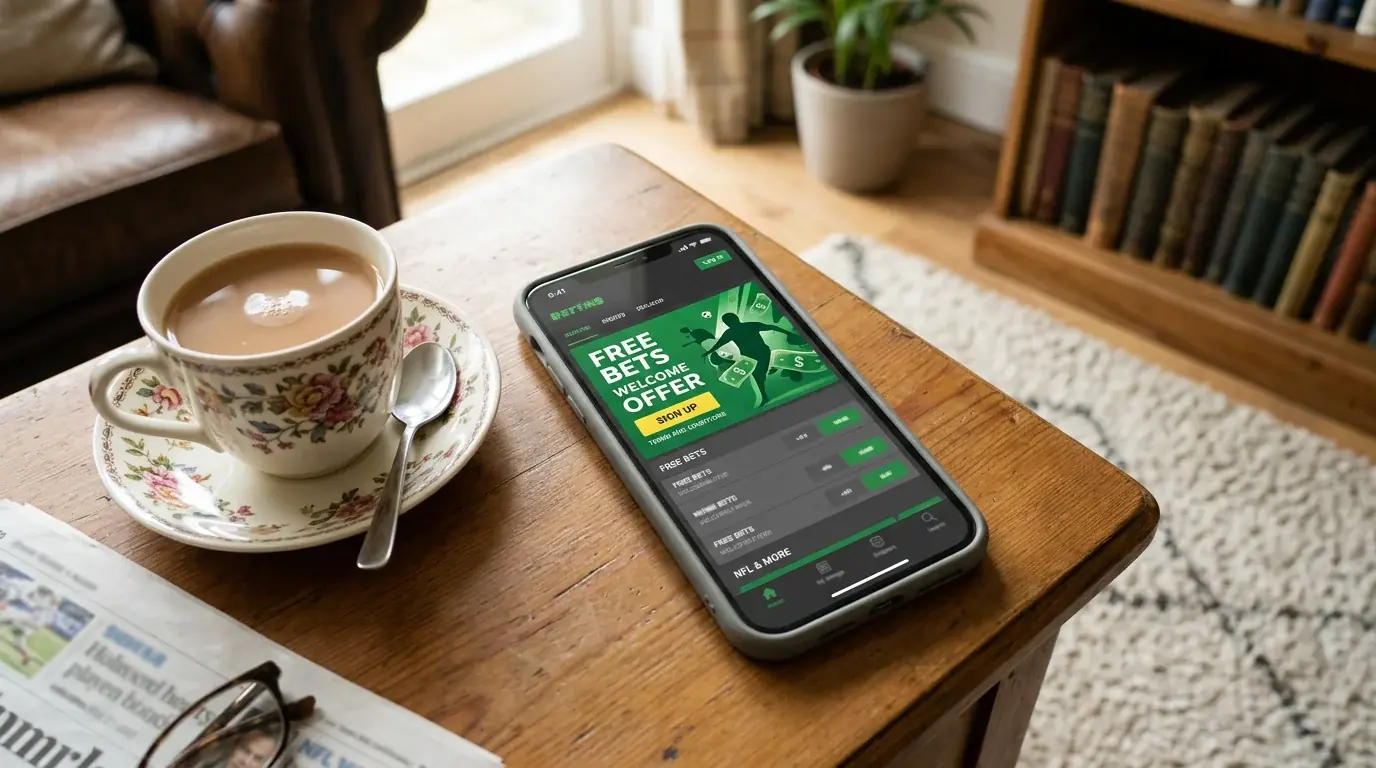
Sky Sports carries the most comprehensive live NFL coverage in the UK, and bettors with a Sky subscription can watch via the Sky Go app while placing bets on a separate platform. The dual-screen setup — television for the game, phone or tablet for the betting app — is the most common arrangement among serious UK NFL bettors I know. It keeps the viewing experience uninterrupted while allowing rapid bet placement during commercial breaks or official timeouts.
NFL Game Pass through DAZN provides an alternative for cord-cutters. The platform offers every game live and on demand, with statistical overlays that include drive charts, player snap counts, and red-zone efficiency data. For live betting purposes, those overlays reduce the need to toggle between apps for information. You can see that a team has converted four of five third downs in the first half without leaving the stream, and that data point directly informs your second-half spread assessment.
The 25% engagement lift from streaming integration, reported across the wider sports betting market, is not just a feel-good number for operators. It reflects genuine behavioural change. Bettors who watch live are more likely to place multiple in-play wagers, more likely to use cash-out features, and more likely to return for the next game. From a personal standpoint, I place roughly three times as many live bets when I have video compared to stat-only sessions — not because I am being reckless, but because I can see opportunities that the data feed does not surface quickly enough.
Quarter-by-Quarter Betting Approach
Not all quarters are created equal, and treating a sixty-minute NFL game as a single betting event is like treating four separate matches as one. Each quarter has its own rhythm, its own tendencies, and its own opportunities. Here is the framework I use, built from seven seasons of tracking quarter-by-quarter scoring patterns.
The first quarter is the most scripted period in football. Offensive coordinators spend all week crafting their opening fifteen to twenty plays, and those sequences are rehearsed to near-perfection. Scoring in Q1 tends to be lower than the game average because both defences are fresh and because teams are running their prepared scripts rather than reacting to what the opponent shows. For live bettors, the Q1 under on the quarter total is often a decent starting position — but the value evaporates if one team scores quickly on an opening-drive big play, which resets the entire quarter pricing.
The second quarter is where adjustments begin. Defensive coordinators have now seen the opponent’s opening game plan and start making scheme changes. Offences that found easy yards in Q1 may struggle as coverages shift. Conversely, teams that stalled early sometimes find rhythm as they move beyond their scripted plays into more fluid, reactive calls. The end of the first half introduces a specific dynamic: the two-minute drill. Teams with strong two-minute offences can score quickly before halftime and then receive the second-half kickoff, creating a potential ten-point swing in a matter of minutes. Betting on “team to score last before halftime” or on a high-scoring late Q2 is one of the more overlooked in-play angles.
Third-quarter scoring patterns depend heavily on coaching philosophy. Some head coaches are famous for their halftime adjustments — they come out of the break with a revised game plan that catches the opponent flat-footed. Others run the same playbook regardless of what happened in the first half. If you know which type of coach is leading each team, you have an informational advantage in the Q3 live markets. Historically, third quarters produce slightly fewer points than Q2 or Q4, partly because both teams are recalibrating and partly because clock management becomes more conservative if the score is close.
The fourth quarter is where live betting gets both exciting and treacherous. If the game is competitive, you see high-stakes decisions: fourth-down gambles, aggressive passing, and defensive schemes that sacrifice field position for turnovers. If the game is a blowout, you enter “garbage time” — the losing team throws freely against a prevent defence, padding stats without genuinely threatening the outcome. Garbage time distorts raw statistics and can make a losing team’s final stat line look far better than their actual performance. For live bettors, this is a trap. Backing the underdog spread in garbage time feels intuitive because they are “closing the gap,” but the covering happens on meaningless plays that the favourite’s defence is deliberately conceding. My rule: if a team is down by three scores in the fourth quarter, do not chase the live spread unless you have a structural reason to believe a genuine comeback is underway.
Overtime in the NFL uses a modified sudden-death format that creates a binary-outcome market. The team that wins the coin toss typically elects to receive, and if they score a touchdown on their opening possession, the game ends immediately. This format heavily favours the toss winner, which means overtime live spreads can be volatile. If you are still awake when an NFL game reaches overtime in UK time — and that usually means 02:30 or later — the discipline advice from earlier in this article applies doubly.
NFL Live Betting Questions
Live betting on NFL games raises practical questions that pre-match wagering does not, mostly because the speed and volatility of in-play markets demand clearer rules of engagement. These are the queries UK punters ask most frequently about in-play NFL wagering.
UK bookmakers do suspend NFL live markets during official reviews, and the suspension applies to all in-play markets for that game — not just the market most directly affected by the review. A disputed catch, a potential fumble, or a scoring play under review will trigger a blanket suspension that lasts until the officials make their ruling. Any bet submitted during the suspension is rejected. The delay is usually one to three minutes, but contentious calls can stretch longer, particularly in the second half of close games where the stakes are highest.
Cash-out on NFL live bets is available at most major UK sportsbooks, though the specific terms vary. Full cash-out settles your bet at the current market value before the game ends. Partial cash-out lets you take a portion of the value while leaving the rest active. The cash-out offer recalculates continuously based on the live odds, so a bet that shows a profitable cash-out in the second quarter might show a loss by the fourth if the game shifts. Not all markets are eligible for cash-out — some props and exotic in-play bets exclude the feature entirely. Check the terms before placing a bet if cash-out flexibility is important to your strategy.
Several UK sportsbooks offer live streaming for NFL games, though the extent of coverage varies. Platforms with direct streaming agreements embed the feed within the betting interface, while others rely on third-party arrangements that may cover only selected games. Sky Bet, as part of the Sky ecosystem, has the broadest NFL streaming access among UK-licensed operators. For games not available via your sportsbook’s stream, NFL Game Pass through DAZN remains the most comprehensive standalone option. The quality of the stream matters for live betting — a reliable feed with minimal delay gives you a genuine edge over bettors relying solely on statistical trackers.
Do UK bookmakers suspend NFL live markets during official reviews?
Yes. All in-play markets for a game are suspended during official reviews. The suspension lasts until the ruling is confirmed, typically one to three minutes. Bets submitted during the suspension are rejected.
Can I cash out an NFL live bet before the game ends?
Most major UK sportsbooks offer full or partial cash-out on live NFL bets. The cash-out value changes continuously with the live odds. Not all markets support cash-out, so check the terms before placing your bet.
Which UK sportsbooks offer live streaming for NFL games?
Several UK platforms stream NFL games within their betting interface, with Sky Bet having the broadest access. Coverage varies by game and platform. NFL Game Pass through DAZN provides the most complete standalone option.
Prepared by the Online Betting nfl Games editorial staff.