NFL Betting Odds Explained for UK Punters: Fractional, Decimal and American
 Available in US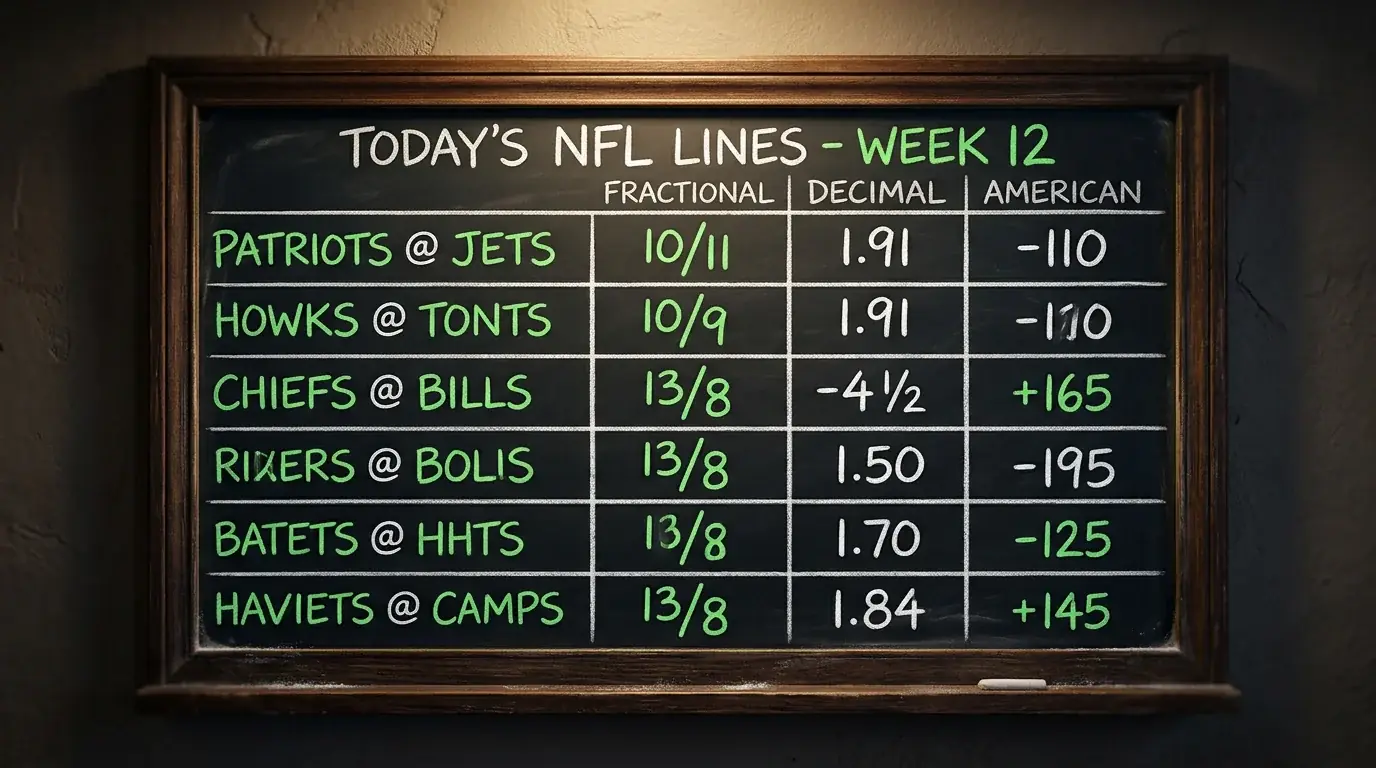
Table of Contents
NFL Betting Odds Explained for UK Punters
I still remember the first time I tried to back the Kansas City Chiefs on a US-facing odds board. The number said -150, and I sat there for a solid minute thinking someone had made a formatting error. Where was the fraction? Where was the slash? Seven years of covering NFL markets for a UK audience have taught me that this moment of confusion is almost universal among British punters — and entirely unnecessary once you spend twenty minutes learning the mechanics.
The NFL now pulls roughly 1.2 million search queries every month from UK users alone, a figure that represents about 13% of the search volume the Premier League generates. That is not a niche curiosity; it is a genuine market force. And as more UK bookmakers dedicate shelf space to American football, they increasingly display odds in formats that were never designed for a British eye. You will see fractional prices on one tab, decimal on another, and American lines on a third — sometimes all on the same slip.
This article walks through each format in detail: how to read it, how to calculate your return, and — most importantly — how to convert between them so you can compare value across platforms. I have built these explanations around real NFL scenarios, because abstract maths sticks far better when there is a game attached to it. If you have ever stared at +130 and wondered whether that is better or worse than 13/10, you are in the right place.
Understanding odds is not a nice-to-have skill. It is the foundation that every other betting decision sits on. You cannot evaluate whether a spread offers value, or whether a prop market is overpriced, unless you know what the numbers actually mean. So let’s start with the format you already know.
Fractional Odds: The UK Standard
A punter in a William Hill shop on a Saturday afternoon does not need an explanation of fractional odds — they are the native language of British betting. But applying that language to NFL games reveals a few wrinkles that football-only bettors rarely encounter, so it is worth resetting the basics before layering on the American football specifics.
Fractional odds express your potential profit relative to your stake. A price of 5/1 tells you that for every pound you wager, you receive five pounds in profit if the bet wins, plus your original stake back. The number on the left is profit; the number on the right is stake. Simple enough when the fraction is clean, but NFL markets regularly throw up prices like 11/8 or 7/4 that demand a moment’s arithmetic.
Here is a concrete example. Suppose the Detroit Lions are listed at 7/4 to beat the Philadelphia Eagles in a Week 6 matchup. A ten-pound stake returns a profit of ten multiplied by seven, then divided by four — that gives you seventeen pounds fifty in profit, plus your ten-pound stake back, for a total return of twenty-seven pounds fifty. The formula never changes: profit equals stake multiplied by the numerator, divided by the denominator.
The distinction between “odds-on” and “odds-against” matters more in NFL markets than many UK punters realise. When a team is heavily favoured — say the Chiefs are priced at 2/5 to beat the Carolina Panthers — you are in odds-on territory. Your profit is smaller than your stake. Ten pounds at 2/5 returns just four pounds profit. This is common on NFL moneyline markets where one side is a clear favourite, and it is exactly the scenario that pushes many bettors toward the point spread instead, where the prices are typically closer to even money.
One detail worth flagging: UK bookmakers sometimes display NFL fractional odds at slightly different granularity than they use for horse racing. You might see 13/10 rather than the more traditional 6/4, even though the two are close in value. This happens because the odds are being converted from an American or decimal source, and the bookmaker rounds to the nearest fraction that fits their board. The practical impact is small, but it means you should always check the decimal equivalent if you want precision.
Fractional odds also communicate implied probability, which is the bookmaker’s estimate of how likely an outcome is. To calculate it, divide the denominator by the sum of both numbers. At 7/4, the implied probability is four divided by eleven — roughly 36.4%. That number is the market’s view of the Lions’ chances. If your own analysis puts their probability higher, you may have found value. We will come back to this concept in depth later.
Decimal Odds and Why Exchanges Use Them
I switched to decimal odds about four years ago, and I have never looked back. The conversion happened gradually — I started using Betfair for NFL player props, the exchange displayed everything in decimals, and within a few weeks fractional felt clunky by comparison. Decimal odds are not inherently better or worse, but they are faster to work with when you are comparing lines across multiple bookmakers at midnight on a Sunday.
The format is straightforward. A decimal price of 2.75 means that for every pound staked, your total return is two pounds seventy-five. That figure includes your stake, so profit is simply the decimal minus one, multiplied by your stake. Ten pounds at 2.75 returns twenty-seven fifty total — seventeen fifty profit. Notice that is the same result as 7/4 fractional. The two formats express the same price, just packaged differently.
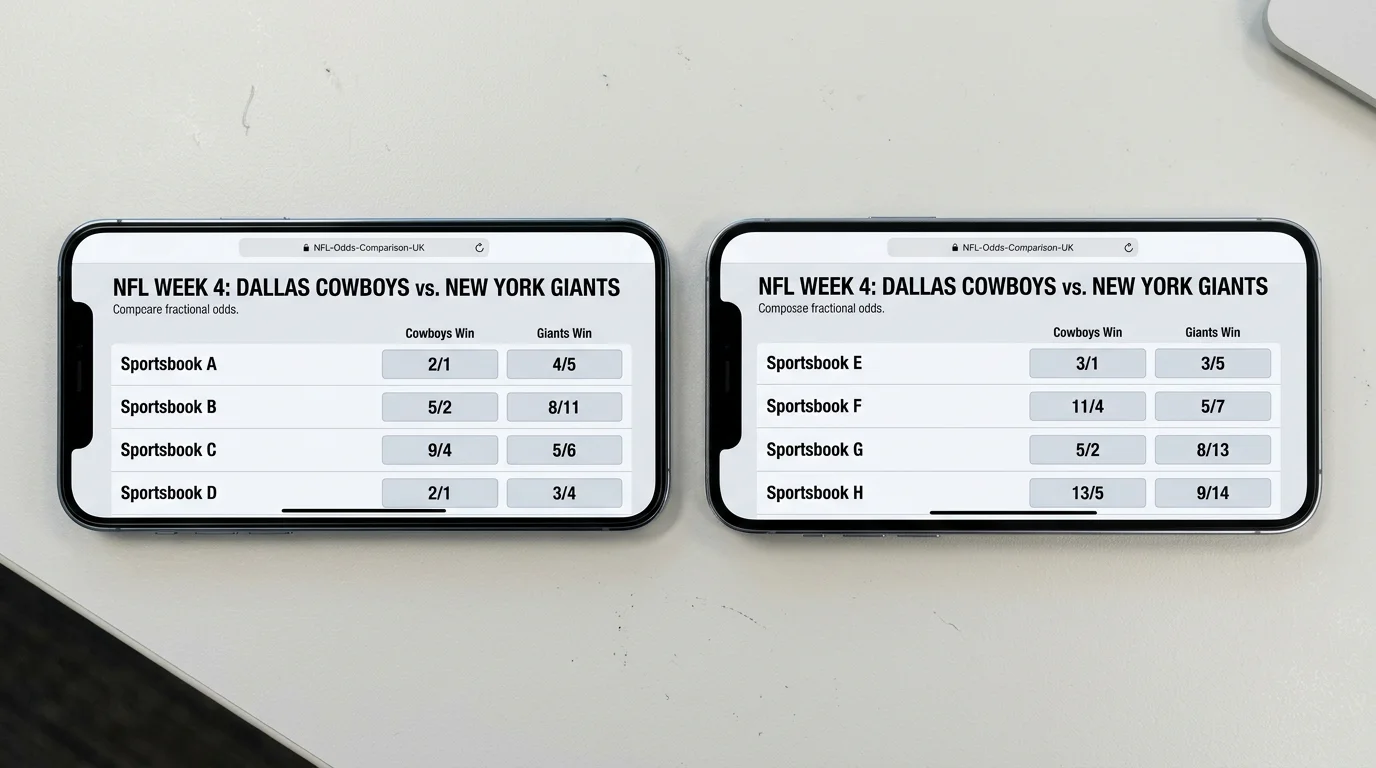
Where decimals shine is comparison. If one bookmaker offers the Buffalo Bills at 2.40 and another at 2.50, you know instantly that the second price is more generous. With fractional odds, those same prices might appear as 7/5 and 6/4, and you would need a few seconds of mental arithmetic to confirm which is better. When you are line-shopping across four or five platforms during a Thursday Night Football window, those seconds add up.
The online segment already accounts for 78.47% of UK sports betting revenue, and that share is climbing. Exchanges and newer digital-first platforms default to decimal because it suits algorithmic pricing and rapid market updates. If you plan to do any serious NFL betting online — and given the time zones, almost all UK NFL betting happens online — getting comfortable with decimals is a practical advantage.
Converting from fractional to decimal takes one step: divide the fraction, then add one. So 5/2 becomes 2.5 plus one, which is 3.50. Going the other direction — decimal to fractional — subtract one, then express the result as a fraction in its simplest form. A price of 1.80 becomes 0.80, which is 4/5. These conversions become second nature after a handful of bets, and most UK apps let you toggle between formats with a single tap.
One caveat: decimal odds display the overround (the bookmaker’s margin) more transparently than fractional. If you add the inverse of each decimal price in a two-way market, any total above one hundred percent reveals the margin. That transparency is another reason I gravitate toward decimals when I am doing pre-match analysis on NFL games.
American Odds: Reading the Lines UK Bookmakers Display
Here is the format that trips up most British punters, and frankly, it tripped me up too. American odds use a plus or minus sign followed by a number, and the logic reverses depending on which sign you are looking at. It feels arbitrary until you understand the anchor point: the number one hundred.
A minus sign indicates the favourite. The number tells you how much you need to stake to win one hundred units. So -150 means you must risk one hundred and fifty pounds to win one hundred pounds profit. A plus sign indicates the underdog. The number tells you how much you win from a one-hundred-pound stake. So +200 means a hundred-pound bet returns two hundred pounds profit.
Let’s ground this in a real scenario. The San Francisco 49ers are listed at -180 to beat the Arizona Cardinals, while the Cardinals are at +155. If you back the 49ers with a thirty-pound stake, your profit calculation is thirty divided by 180, then multiplied by one hundred — that is sixteen pounds sixty-seven profit. If you back the Cardinals at +155 with the same thirty-pound stake, your profit is thirty multiplied by 155, divided by one hundred — forty-six pounds fifty profit. The risk-reward balance is visible immediately: the favourite requires more risk for less reward.
Converting American odds to decimal is mechanical. For a negative American line, divide one hundred by the absolute value and add one. So -150 becomes (100 / 150) + 1 = 1.667. For a positive line, divide the number by one hundred and add one. So +200 becomes (200 / 100) + 1 = 3.00. From there, you can convert to fractional if you prefer that lens.
Why do UK bookmakers bother showing American odds at all? Because NFL-specific content — podcasts, analysis sites, social media — overwhelmingly uses American format. When a popular handicapper tweets that a line has moved from -3.5 (-110) to -3 (-115), a UK punter who can read those numbers natively saves time and avoids misinterpretation. Several major UK platforms now let you view NFL markets in American format alongside fractional or decimal, specifically because their NFL customer base asked for it.
The -110 figure you see attached to spread and totals bets deserves special attention. It is the standard “juice” or “vig” — the bookmaker’s commission built into the price. At -110 on both sides, you are effectively paying a 4.55% margin. When a UK bookmaker shows the same market at 10/11 fractional or 1.91 decimal, all three numbers represent the same underlying price. Recognising that equivalence is the single most useful skill in cross-format literacy.
I now keep my primary NFL account set to American odds and my football account set to fractional. The mental separation helps me switch context between the two sports without confusing price signals. It is a personal quirk, but several bettors I know have landed on the same approach.
Implied Probability and Finding Value
Every odds format is just a different costume for the same underlying concept: probability. Strip away the fractions and plus signs, and what remains is the bookmaker’s estimate of how likely something is to happen — with a margin baked in for their trouble. Learning to extract that probability, and then compare it to your own assessment, is where betting stops being a guessing game and starts being an analytical exercise.
The formulas are simple enough to memorise. For fractional odds, implied probability equals the denominator divided by the sum of numerator and denominator, multiplied by one hundred. At 3/1, that is 1 / (3 + 1) = 25%. For decimal odds, divide one by the decimal and multiply by one hundred. At 4.00, that is 1 / 4 = 25%. For American odds, it splits by sign: for minus lines, divide the absolute value by (the absolute value plus one hundred) and multiply by one hundred. At -200, that is 200 / 300 = 66.7%. For plus lines, divide one hundred by (the line plus one hundred). At +300, that is 100 / 400 = 25%.
Here is where it gets interesting for NFL bettors. Take a standard game-day spread market: Team A at -110 and Team B at -110. Each side implies a probability of 52.38%. Add both, and you get 104.76% — not one hundred. That extra 4.76 percentage points is the overround, or vig, and it represents the bookmaker’s built-in margin. The UK online sports betting market generated $11.2 billion in revenue in 2024, and a meaningful portion of that came from this margin, compounded across millions of bets.
To find “true” implied probability, you need to remove the overround. The simplest method is proportional: divide each side’s raw implied probability by the total of both sides. In the example above, each side’s true probability is 52.38 / 104.76 = 50%. That tells you the market views the game as a coin flip once the margin is removed. If your research suggests one team genuinely wins 55% of the time against the spread, you have identified value.
Value is not about picking winners. I need to stress this because it is the single most misunderstood concept among new NFL bettors in the UK. Value means backing outcomes where the true probability exceeds the implied probability. You will still lose plenty of individual bets. But over a large sample, consistently finding two or three percentage points of edge compounds into meaningful returns. The maths is unforgiving in the other direction, too — bet without an edge, and the overround grinds your bankroll down game by game.
A practical tip: I keep a spreadsheet that converts every NFL line I am considering into implied probability, removes the vig, and compares it to my own power ratings. The process takes about ten minutes per game week, and it has saved me from dozens of bets that “felt” right but were mathematically poor. You do not need complex modelling software to do this; a basic understanding of handicap betting and a calculator will get you most of the way there.
How NFL Lines Move and What It Means for UK Bettors
Last October, I watched a Thursday night line shift by a full point in under ninety minutes. The Green Bay Packers opened as three-point favourites, and by the time I finished dinner, they were at -4. A starting quarterback had been listed as questionable on the injury report, and sharp bettors — the high-volume professionals who move markets — had hammered the other side before the books adjusted. By the time the casual public caught up, the value had already vanished.
Line movement is the visible trace of money flowing into a market. When Americans wagered approximately $30 billion on the NFL season in 2025, every dollar of that carry exerted pressure on the odds. Bookmakers do not set lines based purely on their own analysis; they react to betting volume and the composition of that volume. A flood of small recreational bets might not move a line at all, but a single large bet from a respected sharp account can trigger an immediate adjustment.
For UK punters, the time-zone difference creates both a challenge and an opportunity. NFL opening lines typically appear on Sunday evening US time, which is late Sunday night or early Monday morning in the UK. By the time you sit down with your morning coffee on Monday, the line may already have moved from its opener. If you are the type to bet early in the week, setting an alarm for those initial releases can give you access to numbers that will not exist by Wednesday.
Several factors drive line movement beyond raw betting volume. Injury reports are the most obvious — a starting running back ruled out on Friday can swing a spread by two or three points. Weather forecasts matter for outdoor games, especially totals markets: a forecast of forty-mile-per-hour winds at Soldier Field typically pushes the total down. And then there are the less visible forces: coaching changes, leaked game-plan information, and the cascading effect of one bookmaker moving a line and others following to avoid exposure.
The head of the UK Gambling Commission noted in early 2025 that overall gambling participation has remained roughly flat — about half the adult population engages regularly — and that growth in one product tends to come at the expense of another. Horse racing participation dropped to 4% in Q4 2025, while sports like NFL and basketball gained ground. That rebalancing means more UK-based money is flowing into NFL markets, and as that volume grows, the lines UK bookmakers offer will increasingly reflect local as well as US-driven movement.
My practical advice: track where a line opens and where it closes. Over time, you will start to recognise patterns — which games attract sharp action early, which games move late on injury news, and which lines barely budge despite heavy public interest. That pattern recognition is not a magic formula, but it gives you a framework for deciding when to bet, not just what to bet on.
Common Questions About NFL Odds
Odds formats generate more questions than almost any other topic in NFL betting, and most of them boil down to the same underlying confusion: why are there three systems for expressing the same price? The short answer is history and geography. The longer answer is that each format has a practical strength, and knowing when to lean on which one makes your betting life considerably easier. Here are the questions I hear most often.
UK bookmakers show American odds for NFL games because the sport’s analytical ecosystem runs on that format. When injury analysts, line-setters, and podcasters discuss a game, they reference -110 or +150 — not 10/11 or 6/4. Rather than force UK customers to translate every piece of pre-match research, bookmakers now offer American odds as a toggle option. It saves time and reduces the risk of misreading a line during a live betting window when every second counts.
A negative number in NFL betting lines indicates the favourite and tells you how much you need to stake to win one hundred units of profit. The larger the negative number, the heavier the favourite. A line of -300 means the bookmaker considers the outcome highly likely — you would need to risk three hundred pounds to win one hundred. By contrast, a small negative number like -105 indicates a near coin-flip market with minimal separation between the two sides.
Calculating your exact payout from fractional NFL odds requires one multiplication and one division. Multiply your stake by the numerator, then divide by the denominator — that gives your profit. Add your original stake to get the total return. For a twenty-pound bet at 9/2, profit is twenty multiplied by nine, divided by two: ninety pounds. Total return is one hundred and ten pounds. The formula works identically whether the odds are 1/5 or 50/1.
The overround is the margin built into a set of odds that ensures the bookmaker profits regardless of the result. In a two-outcome NFL market, you calculate it by converting each side’s odds into implied probability and summing the two percentages. If the total exceeds one hundred percent, the excess is the overround. A typical NFL spread market carries an overround of around four to five percent. Lower overrounds mean more of your stake goes toward potential winnings rather than the bookmaker’s margin, so comparing overrounds across platforms is a direct way to measure which bookmaker offers better value for NFL bettors.
Why do some UK bookmakers show American odds for NFL games?
Because the NFL analytical community — podcasters, handicappers, line trackers — uses American format universally. Offering it as a toggle lets UK punters read pre-match research without constant conversion. Most major UK apps let you switch between fractional, decimal and American with a single tap.
What does a negative number mean in NFL betting lines?
A negative number identifies the favourite. It tells you how much you need to stake to win 100 units of profit. For example, -150 means you risk 150 pounds to win 100 pounds. The larger the negative number, the stronger the favourite in the bookmaker’s view.
How do I calculate my exact payout from fractional NFL odds?
Multiply your stake by the top number of the fraction, then divide by the bottom number. That gives your profit. Add your original stake for the total return. A 20-pound bet at 9/2 returns 90 pounds profit plus your 20-pound stake, for a total of 110 pounds.
What is the overround and how does it affect NFL odds value?
The overround is the bookmaker’s built-in margin. Convert each outcome’s odds to implied probability and add them together. If the total exceeds 100%, the excess is the overround. A typical NFL spread market carries a 4-5% overround. Lower overrounds mean better value for the bettor.
Created by the ”Online Betting nfl Games” editorial team.