NFL Weather Betting: How Conditions Shape the Lines
 Available in US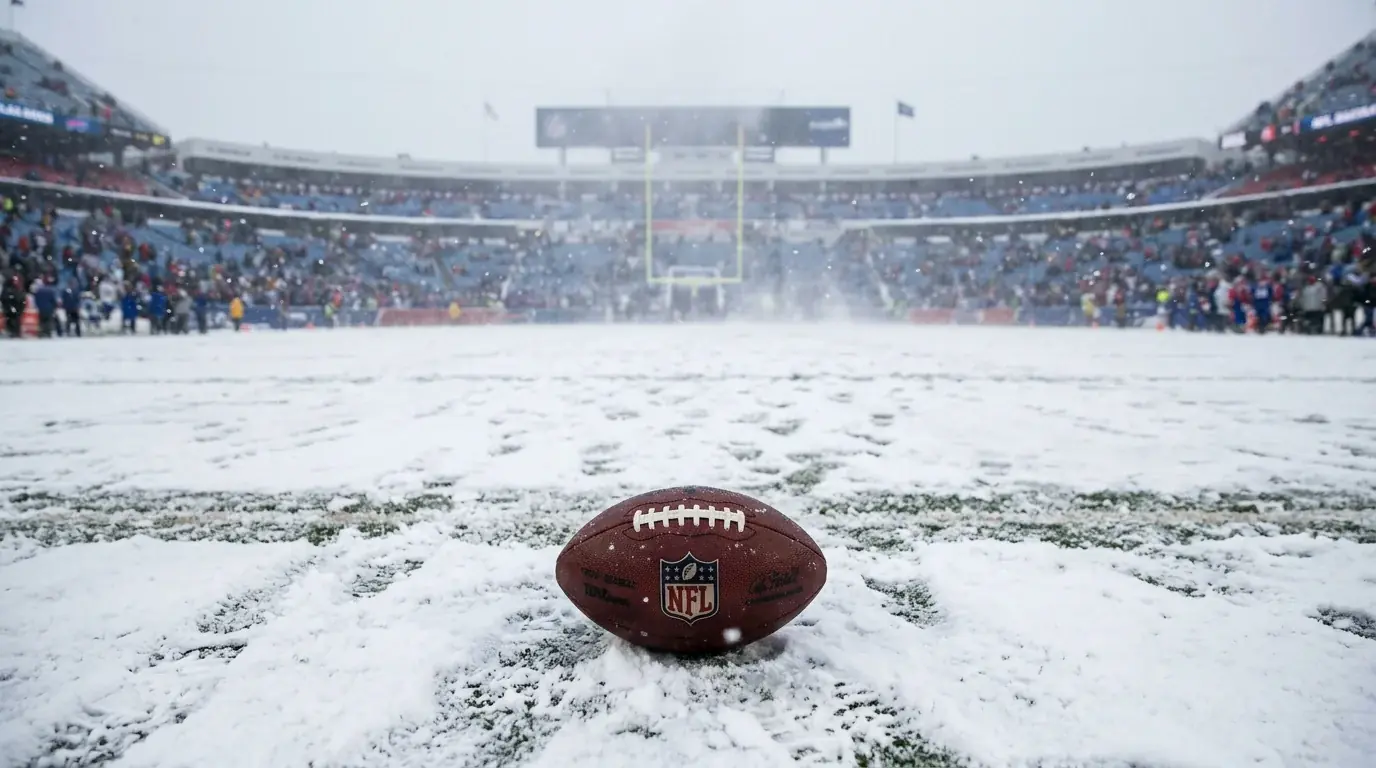
NFL Weather Betting: How Conditions Shape the Lines
In December 2022, a Bills-Bears game kicked off in Chicago with wind gusts exceeding 40 mph. The total was set at 41.5. The final score was 35-13 — 48 combined points, comfortably over. Every model I had said that wind would depress scoring, and instead both teams ran the ball effectively enough to produce a shootout. That game taught me that weather analysis for NFL betting is not as simple as “wind equals under.” It is a variable that interacts with team schemes, roster construction and game flow in ways that require genuine analytical depth.
Roughly half of NFL teams play their home games outdoors, which means weather affects at least 8 games per week during the regular season. For UK punters, weather is a relatively minor factor in football betting — most Premier League stadiums produce similar playing conditions regardless of rain or cold. In the NFL, the difference between a 70-degree dome game and a 15-degree outdoor game in Green Bay with 20 mph winds is enormous. Ignoring weather is ignoring one of the most significant variables in American football betting.
Wind Speed and the Passing Game
Wind is the weather factor with the most direct, measurable impact on NFL scoring. Research consistently shows that games played in winds above 15 mph produce lower combined scores than calm-weather games. The mechanism is straightforward: wind disrupts the passing game. Quarterbacks cannot throw with the same accuracy or distance, deep passes become unreliable, and field goal attempts beyond 40 yards become adventures. The passing game is the NFL’s primary scoring engine, and wind is its primary disruptor.
Approximately $30 billion was wagered on the 2025 NFL season through legal US sportsbooks, and sharp bettors in that market treat wind data as a core input for totals analysis. The weather information that moves lines is not available only to insiders — it is freely accessible through the National Weather Service and dedicated NFL weather sites. UK punters who check weather forecasts before placing totals bets gain an edge over the segment of the public that ignores conditions entirely.
The threshold matters. Light wind — under 10 mph — has negligible impact. Moderate wind — 10-15 mph — creates a marginal effect that bookmakers usually price in. Strong wind — 15-25 mph — produces a measurable scoring depression that the market sometimes underprices, particularly early in the week before game-day forecasts are finalized. Extreme wind — above 25 mph — is rare but transformative, turning games into running-centric contests that often produce dramatically low scores.
One nuance that sharps exploit: wind direction relative to field orientation. A crosswind affects passing differently from a headwind or tailwind. Stadiums like Soldier Field in Chicago and Highmark Stadium in Buffalo are oriented so that prevailing winds create specific patterns — a team with the wind at their back in the first and fourth quarters has a different passing environment than their opponent. This level of detail is available through stadium orientation data and localized wind forecasts, and it adds a layer of precision to wind-based totals analysis.
Rain, Snow and Extreme Cold
Rain’s primary impact is on ball security. Wet conditions increase fumble rates — the football becomes slippery, exchanges between centre and quarterback are riskier, and ball carriers struggle to maintain grip through contact. For bettors, rain games tend to produce more turnovers, which creates scoring variance in both directions: turnovers can lead to short-field touchdowns (pushing the total up) or drive-killing mistakes (pushing it down). The net effect on totals is modest, but the effect on individual game flow is significant.
Snow is the wildcard. Light snow has minimal impact — it looks dramatic on television but does not meaningfully affect play. Heavy snow transforms the game. Visibility drops, footing becomes treacherous, and the passing game suffers even more than in wind. The most famous snow games in NFL history produced bizarre, low-scoring outcomes that no model predicted. For bettors, heavy snow games are unpredictable enough that the prudent approach is to reduce stake size rather than try to forecast the outcome with confidence.
Extreme cold — below minus 10 Celsius — occurs primarily at Green Bay, Buffalo and Minnesota (before their dome was built). Cold affects the football itself: the ball becomes harder and less grippy, reducing passing effectiveness and kicking distance. It also affects player conditioning — teams based in warm-weather cities visiting cold-weather venues in December and January face a physiological disadvantage. Tottenham Hotspur Stadium, the NFL’s London home, is the only venue outside the United States specifically designed for American football, and its controlled conditions remove weather variability entirely for International Series games. For London game bettors, this means weather is a non-factor — one fewer variable to model.
Temperature also affects kicking. Field goal range contracts in cold weather — kickers lose 3-5 yards of effective distance in temperatures below freezing. A 48-yard field goal that is routine in a September dome game becomes a marginal attempt in December at Lambeau Field. For prop bettors backing specific kicking outcomes, temperature is a direct input that should adjust your expectations.
One seasonal pattern worth noting: early-season heat affects conditioning, particularly for teams in the first two weeks that have not yet adapted to game-day workloads. Teams in hot-weather venues — Miami, Arizona, Las Vegas (outdoor practices) — gain a small early-season home advantage from heat acclimation. This effect dissipates as the season progresses and all teams reach full fitness.
Where can UK punters check NFL game-day weather forecasts?
The most reliable source is the US National Weather Service, which provides hourly forecasts for every NFL city. Dedicated NFL weather sites aggregate forecasts specifically for game-day conditions, including wind speed, wind direction, temperature and precipitation probability. These forecasts are available on game-day mornings and often sharpen significantly compared to mid-week projections. I check weather forecasts on Saturday evening (UK time) for the Sunday slate, which gives the best balance of accuracy and time to act.
Do indoor NFL games eliminate all weather-related betting angles?
Indoor games eliminate direct weather effects — wind, rain, cold and snow are irrelevant in a dome. However, dome environments create their own analytical dimension. Dome games historically produce higher combined scores than outdoor games, and teams that play their home games indoors can be at a disadvantage when forced to play outdoors in adverse conditions, particularly in the playoffs. For totals bettors, the dome-versus-outdoor distinction is itself a weather-related angle, even though the dome game has no weather in the traditional sense.
Created by the ”Online Betting nfl Games” editorial team.