NFL Betting Glossary: Terms for UK Punters
 Available in US
Table of Contents
NFL Betting Glossary: Terms for UK Punters
The first time I listened to an American NFL betting podcast, I understood roughly half the words. “The chalk is laying 7 through the hook, the dog has moved off the key number, and the steam came in on the under.” Every term in that sentence has a specific meaning that directly affects how you place and evaluate NFL bets, and most of them have no equivalent in UK betting vocabulary. With approximately 14.3 million NFL fans in the UK, a growing number of people are encountering this terminology every week — on American podcasts, social media, fantasy football platforms and betting analysis sites. This glossary bridges the gap between US betting language and UK punter knowledge, organised alphabetically so you can find what you need quickly.
Terms A-K
Action — any bet currently in play. “I have action on the Chiefs” means you have a live bet on them. In the UK, you would simply say you have backed the Chiefs.
Against the spread (ATS) — a team’s record relative to the spread rather than outright wins and losses. A team might be 10-3 in actual results but only 6-7 ATS, meaning they have failed to cover more often than not. ATS records are the primary analytical metric for spread bettors.
Bankroll — the total amount of money you have set aside specifically for betting. Not your savings account, not your rent money — a dedicated fund for wagering. Professional NFL bettors treat bankroll management as the foundation of their entire operation.
Chalk — the favourite in a game. “Betting the chalk” means backing the favourite. Derived from the chalk boards where odds were historically written in American sportsbooks, with the favourite’s line updated most frequently.
Closing line — the final odds offered just before the game starts. Beating the closing line — getting a better price earlier in the week than the line closes at — is considered the single best indicator of long-term betting profitability.
Cover — when a team wins by more than the spread. If the Chiefs are -6.5 and win by 10, they covered. If they win by 3, they failed to cover. This is the most common verb in NFL betting vocabulary.
Dog — short for underdog. The team receiving points on the spread or listed at plus money on the moneyline. “Live dog” refers to an underdog with a genuine chance of winning outright.
Edge — your advantage over the bookmaker on a specific bet. If you believe a team has a 55% chance of covering but the implied probability from the odds is only 52%, your edge is approximately 3%.
Futures — bets on outcomes that will be determined at a later date, such as Super Bowl winner, MVP, or season win totals. The UK equivalent is ante-post betting.
Gridiron — American football, named for the grid-like pattern of yard lines on the field. The term is used more commonly in UK and international contexts than in the US itself.
Handle — the total amount of money wagered on an event or market. The handle on Super Bowl LX was approximately $1.71-1.76 billion. UK punters might recognise this as “total turnover.”
Hook — the half point in a spread. A spread of -3.5 is said to include the hook, while -3 does not. Buying or selling the hook refers to moving the spread by half a point.
Juice — the commission or margin built into the odds by the bookmaker. Synonymous with “vig” (vigorish). On a standard -110 line, the juice is approximately 4.5%. The UK equivalent is “overround.”
Key number — a margin of victory that occurs with higher-than-average frequency due to the NFL’s scoring structure. The primary key numbers are 3 and 7, driven by field goals and touchdowns.
Terms L-Z
Lay — in exchange betting, to bet against an outcome. UK punters familiar with Betfair already understand laying. In traditional US sportsbook terminology, “laying points” means betting on the favourite (giving the spread).
Line — the odds or spread on a game. “The line on the Chiefs is -3.5” means the spread. “The line moved from -3 to -3.5” describes line movement. Broadly synonymous with “price” or “odds” in UK terminology.
Lock — a bet perceived as a guaranteed winner. In reality, no bet is a lock. The term is used most often on social media and should be treated with extreme scepticism. If someone calls a bet a lock, they are expressing confidence, not certainty.
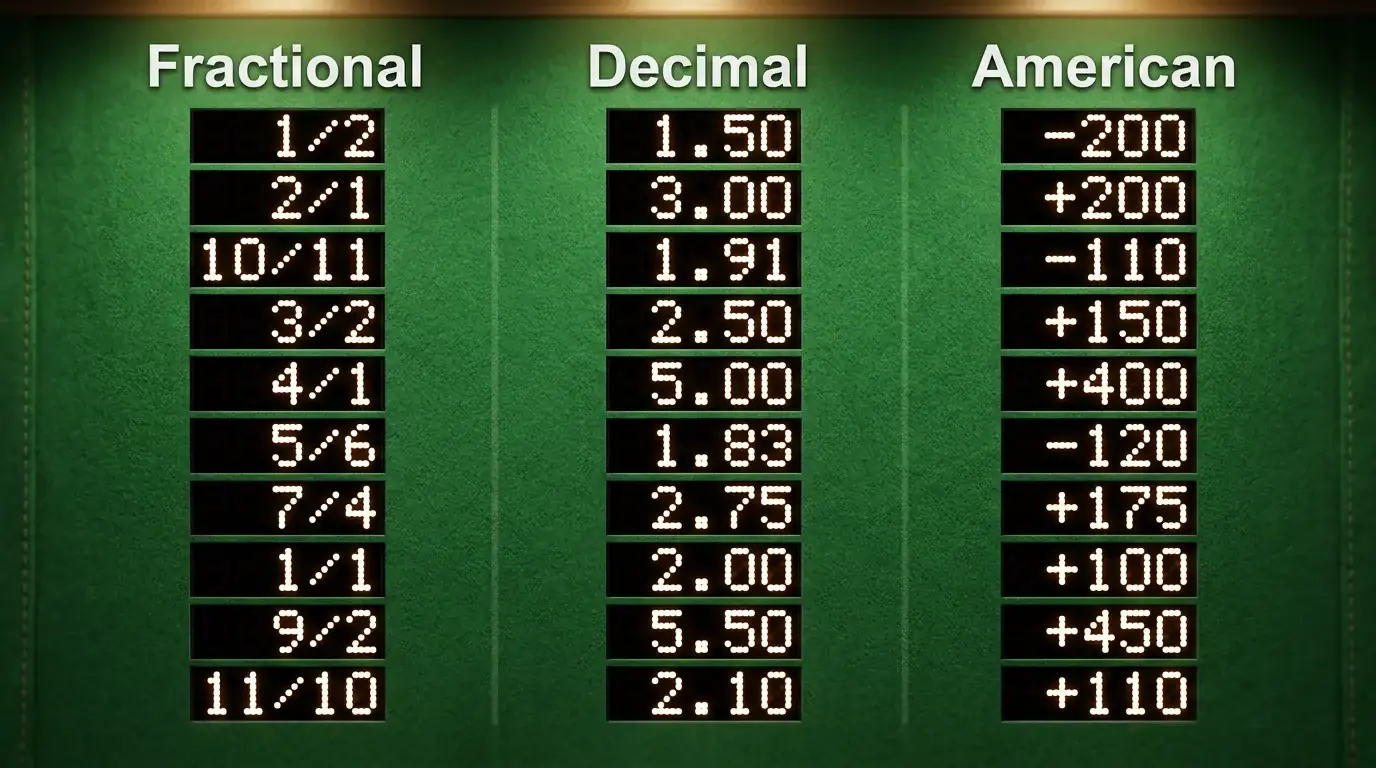
Moneyline — a bet on which team will win outright, with no spread applied. The UK equivalent is “match winner” or “outright.” Moneyline odds in American format use plus and minus notation.
Off the board — a game that the bookmaker has temporarily removed from the betting menu, usually due to a major injury or other breaking news that makes the existing line obsolete. UK bookmakers might describe this as “suspended.”
Parlay — the American term for an accumulator. Multiple selections combined into a single bet where all legs must win. Prop bets accounted for 60% of wagering on Super Bowl LIX, and many of those were parlay legs.
Pick ’em — a game with no spread, where neither team is favoured. Both teams are priced as though the matchup is even. In the UK, this is similar to both sides being offered at around 10/11.
Prop (proposition bet) — a bet on a specific occurrence within a game rather than the final outcome. Player props (passing yards, touchdowns) and game props (first scoring play, total sacks) are the two main categories.
Push — a bet that results in a tie against the spread, with stakes returned. Occurs when the margin of victory lands exactly on the spread number. Half-point spreads eliminate the possibility of a push.
Return — the total amount paid back on a winning bet, including the original stake. A £10 bet at 2/1 returns £30 (£20 profit plus £10 stake). UK punters generally distinguish between “return” (total payout) and “profit” (winnings minus stake).
Sharp — a professional or highly skilled bettor whose action moves lines. “Sharp money” refers to wagers placed by these informed bettors, as opposed to “public money” from recreational bettors. Bookmakers track sharp action closely and adjust their lines accordingly.
Spread — the point handicap applied to a game. The favourite “gives” points (e.g., -3.5) and the underdog “receives” points (e.g., +3.5). The spread is the most popular NFL betting market in the United States.
Steam — rapid, significant line movement driven by heavy one-sided betting. “Steam on the under” means the total line is dropping quickly because large bets are hitting the under side. Steam moves typically originate from sharp action.
Teaser — a parlay where you buy additional points on the spread for each leg in exchange for reduced odds. A 6-point teaser on a -7 line moves it to -1. Not widely available at UK bookmakers.
Total — the combined score line set by the bookmaker for a game. Bettors choose over or under. Also called the over/under. A total of 47.5 means you are betting on whether the combined final score exceeds or falls short of 47.5 points.
Underdog — the team expected to lose, receiving points on the spread and listed at plus money on the moneyline. Abbreviated as “dog.”
Vig (vigorish) — the bookmaker’s built-in commission on a bet. On standard -110 / -110 pricing, the vig equates to approximately 4.5%. The UK term “overround” captures the same concept expressed as a percentage above 100% across all outcomes in a market.
Wager — a bet. Used more frequently in American betting terminology than in the UK, where “bet,” “punt” or “stake” are more common. The terms are interchangeable.
What is the UK equivalent of the American betting term parlay?
The UK equivalent of a parlay is an accumulator, commonly shortened to ‘acca.’ Both terms describe a single bet that combines multiple selections, where every leg must win for the bet to pay out. The mechanics, mathematics and risk profile are identical — the only difference is the word used. UK bookmakers list this product as ‘accumulator’ or ‘multi-bet’ rather than ‘parlay,’ though some platforms that cater to international audiences may use both terms.
What does vig mean in NFL betting and how does it differ from UK overround?
Vig — short for vigorish — is the bookmaker’s commission built into the odds. On a standard NFL spread bet priced at -110 on both sides, the vig is approximately 4.5%. The UK term ‘overround’ captures the same concept differently: it measures the total implied probability across all outcomes in a market. If both sides of a spread are -110, the combined implied probability is 104.76%, meaning the overround is 4.76%. Both terms describe the bookmaker’s margin — vig focuses on the individual bet’s cost, while overround focuses on the market’s overall excess probability.
Written by the editors at Online Betting nfl Games.