NFL Point Spread Betting: The Handicap UK Punters Need to Master
 Available in US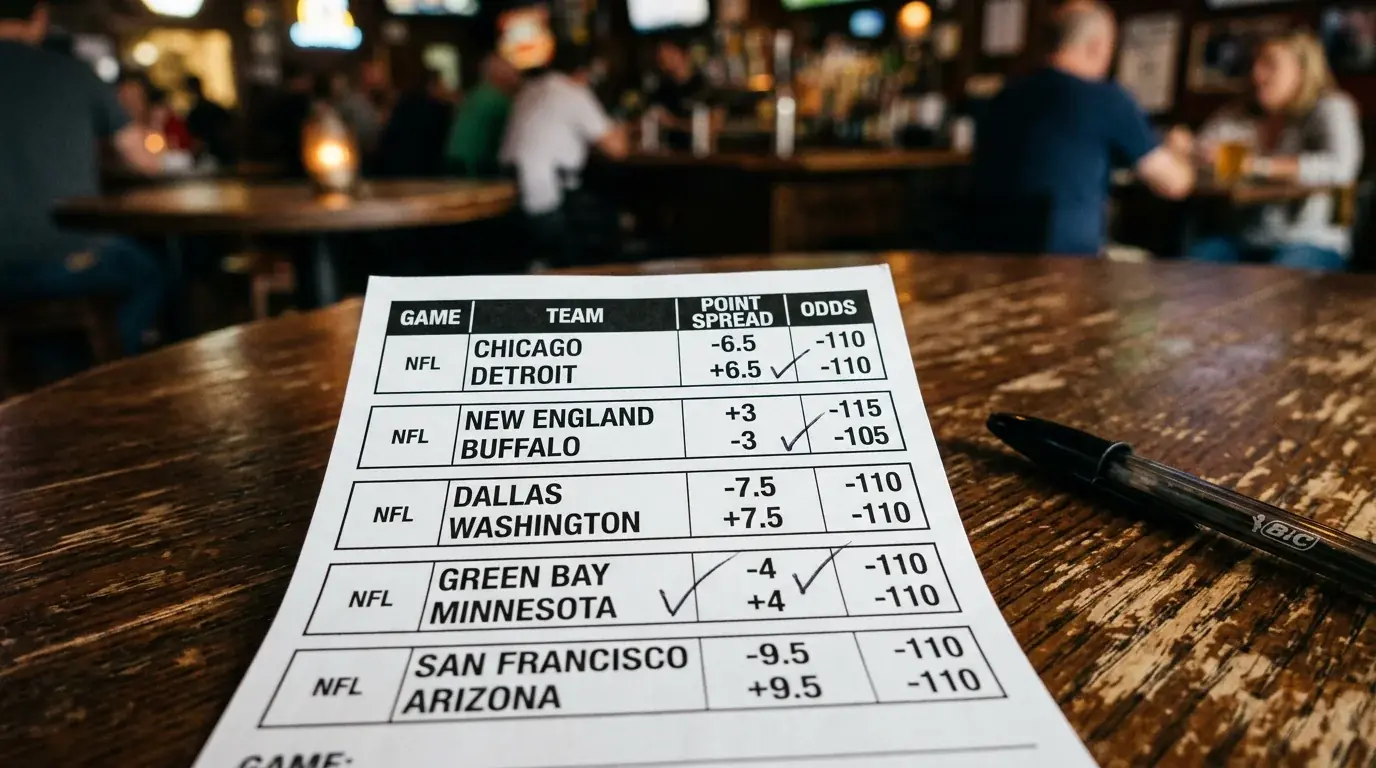
NFL Point Spread Betting: The Handicap UK Punters Need to Master
I placed my first NFL spread bet in 2019, and I got it spectacularly wrong. Not because I picked the wrong team — I actually had the winner right — but because I had no idea what “covering the spread” meant. I backed the Kansas City Chiefs at -7.5, they won by six, and I sat there at 2am staring at a losing slip for a game my team had won. That moment taught me something every UK punter crossing over from football needs to understand: in NFL spread betting, winning the game and winning the bet are two completely different things.
The point spread is the single most popular betting market in American football. While UK punters instinctively reach for the match winner — what Americans call the moneyline — the spread is where the real action sits across the Atlantic. Approximately $30 billion was wagered on the NFL season in 2025 through legal US bookmakers alone, and the spread accounted for the lion’s share of that handle. For UK bettors, the concept mirrors the Asian handicap you might know from Premier League betting, but with a few critical differences that trip people up.
If you have ever looked at an NFL line and seen something like “Buffalo Bills -3.5” next to odds of 10/11, you have encountered the spread. This article breaks down exactly how it works, when it offers better value than a straight win bet, and why the numbers 3 and 7 should be burned into every NFL punter’s brain.
How the NFL Point Spread Works
A mate of mine who has been betting on Premier League matches for a decade once told me the spread “just looked like extra maths for no reason.” I get it. But once the logic clicks, you realise it is actually the most elegant market in NFL betting — and the one where bookmakers give you the closest thing to a fair price.
The point spread is a handicap applied to the favourite to level the playing field. When you see the Dallas Cowboys listed at -6.5, it means the Cowboys need to win by 7 or more points for a spread bet on them to pay out. Conversely, their opponents at +6.5 can lose the game by up to 6 points and your bet still wins. The bookmaker is essentially saying: “We think the Cowboys are about 6.5 points better than the other side.”
Here is a worked example. Suppose the line reads:
Green Bay Packers -3.5 (10/11)
Detroit Lions +3.5 (10/11)
If you back Green Bay at -3.5 and they win 27-21 — a margin of 6 — your bet wins. They covered the spread. But if they win 24-23, a margin of just 1, your bet loses because they did not cover the 3.5-point handicap. Meanwhile, anyone who backed Detroit at +3.5 wins in that second scenario, because after adding 3.5 points to Detroit’s final score, they finish ahead.
The odds on either side of the spread typically sit around 10/11 (or -110 in American format, 1.91 decimal). This near-even pricing is deliberate — the bookmaker earns margin through the small gap between the two sides rather than through lopsided odds. That $30 billion wagered on the 2025 NFL season ran largely through this market, and the tight pricing is a major reason why sharps — professional bettors — gravitate toward spread betting over moneyline.
One term you will encounter constantly: “covering.” When a team wins by more than the spread, they “covered.” When they fall short, they “failed to cover.” It is the single most important piece of vocabulary in NFL betting, and you will see it on every results page and analysis site.
A push occurs when the margin of victory lands exactly on the spread number. If the line is -3 and the favourite wins by exactly 3, it is a push and stakes are returned. This is why you see half-point spreads like -3.5 — they eliminate the possibility of a push entirely.
Buying the Half Point and the Hook
The first time someone mentioned “the hook” in an NFL betting conversation, I assumed they were talking about a play on the field. They were not. In spread betting, the hook is the half point — that .5 at the end of a spread line. It sounds trivial. It is anything but.
Consider a line of -3 versus -2.5. That half point is the difference between a push and a win if the favourite takes the game by exactly 3. Given that 3 is the most common margin of victory in the NFL — roughly 15% of all games land on that number — buying from -3 to -2.5 carries real mathematical weight. The same logic applies at 7, the second-most common margin, driven by the combination of a touchdown and extra point.
UK bookmakers that offer NFL markets will sometimes let you buy half a point, but they charge for it through adjusted odds. Moving from -3 to -2.5 might shift your price from 10/11 to 5/6, and you have to decide whether the protection is worth the reduced payout. My general approach: buying through 3 is almost always worthwhile, buying through 7 is often worthwhile, and buying through any other number rarely justifies the cost. The data backs this up — the frequency distribution of NFL margins clusters heavily around those two numbers, and the value of crossing them is well documented. You can dig deeper into that distribution in the guide to NFL key numbers.
One more nuance: some bookmakers offer “alternate spreads” where you can take a team at a much larger or smaller handicap. Backing a heavy favourite at -10.5 instead of -3.5 gives you longer odds but requires a blowout. Taking an underdog at +10.5 gives you a wide cushion but minimal return. These alternate lines create interesting possibilities for punters who have strong views on the likely margin of a game.
When the Spread Outperforms a Straight Win Bet
There is no rule that says you must bet the spread. Plenty of NFL bettors stick exclusively to the moneyline, and there is nothing wrong with that. But understanding when the spread delivers better expected value is a genuine edge, particularly in a UK market worth approximately $11.2 billion in annual online sports betting revenue where competitive pricing means small edges compound.
The spread shines brightest when you are backing heavy favourites. Suppose a team is -350 on the moneyline — that is 2/7 in fractional odds. You need to stake £350 to win £100, and one upset wipes out three and a half winning bets. The same team might be -7.5 on the spread at 10/11. Yes, they need to win by 8 or more, but the return is vastly better relative to risk. If you genuinely believe the favourite will dominate, the spread gives you a much more efficient vehicle.
Where the moneyline pulls ahead is with small underdogs. A team at +2.5 on the spread might be +130 on the moneyline (roughly 13/10). If you think that underdog has a real chance of winning outright — not just keeping it close — the moneyline payout is more attractive. You are giving up the safety net of the 2.5 points, but you are being compensated with better odds.
I tend to use a simple decision filter. If the spread is 6 points or wider and I fancy the favourite, I bet the spread. If the spread is 3 points or narrower and I fancy the underdog, I lean moneyline. Everything in between requires a closer look at the specific pricing, because that middle ground is where the bookmaker’s edge is hardest to crack.
Another scenario worth noting: accumulators. Many UK punters building NFL accas default to moneyline selections because they are simpler. But mixing in spread picks at near-even odds can actually produce more balanced risk profiles across the accumulator. A 4-fold with two moneyline favourites and two spread underdogs creates a different risk shape than four moneyline shorts — and often a healthier one.
How does a push work on an NFL spread bet?
A push happens when the final margin of victory lands exactly on the spread number. For example, if a team is favoured at -3 and wins by exactly 3 points, the bet is a push and your stake is returned. Half-point spreads like -3.5 eliminate pushes entirely. Most UK bookmakers treat a push as a void selection — in an accumulator, that leg is removed and the remaining legs are recalculated at reduced combined odds.
Why do NFL spreads often land on 3 or 7 points?
NFL scoring is built around field goals worth 3 points and touchdowns with extra points worth 7. These scoring units create natural clusters in final margins. Roughly 15% of NFL games finish with a 3-point margin and around 9% finish on 7. These frequencies make 3 and 7 the most significant key numbers in spread betting, which is why moving a line through either number carries real value.
Written by the editors at Online Betting nfl Games.